
Globo explores next-generation broadcast monitoring as Brazil enters the DTV+ era
The FIFA World Cup 2026 has provided more than a showcase for the world’s best football. For broadcasters, it is also one of the most demanding environments in which to put new technologies to the test.
During the World Cup, Globo TV began testing Marquise Technologies’ ICE Live in its DTV+ Laboratory in Rio de Janeiro, exploring how the platform can monitor the advanced technologies shaping the future of television in Brazil.
The timing is particularly significant. With the official launch of DTV+ in Brazil last June, Globo is at the forefront of the country’s transition from traditional broadcasting to a new generation of television, combining UHD video, HDR, Next Generation Audio and increasingly sophisticated viewer experiences.
Globo’s interest in ICE Live comes from its unique ability to visualize the entire DTV+ experience: video and personalized audio together, in sync, with the metadata that drives the experience.

One signal. The complete experience.
Traditional broadcast monitoring has largely treated video and audio as separate technical signals. DTV+ changes that. With HDR video, MPEG-H audio, metadata, personalization and interactive features becoming integral parts of the broadcast, operators need to understand not only whether each component is technically correct, but how all these elements work together as a complete viewer experience.
This is where ICE Live brings a new perspective.
In Globo’s laboratory tests, the signal is carried over 12G-SDI as uncompressed baseband video and audio, with PQ HDR10 video and 16 channels of uncompressed PCM audio including the MPEG-H control track.
ICE Live allows Globo to inspect the complete signal in real time and experience the relationship between video and audio exactly as it is intended to be experienced by the viewer.
See What Your Audio Is Made Of
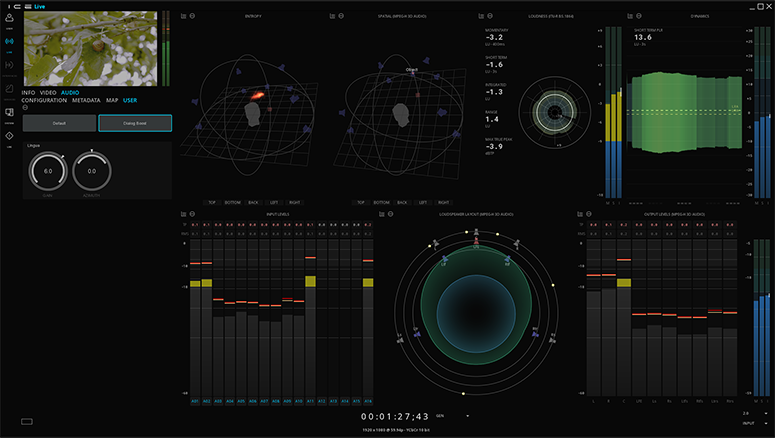
MPEG-H is one of the defining elements of the DTV+ audio experience. Unlike traditional fixed-channel audio, MPEG-H can carry multiple programs, presets and interactive elements, allowing viewers to personalize how they experience a live program.
ICE Live gives Globo direct visibility into these different experiences. Depending on the program, users can verify presets such as the Globo experience, dialogue enhancement or stadium-focused audio, and confirm that the corresponding audio experience is correctly transmitted and rendered.
Audio and video — in context
For next-generation broadcasting, monitoring audio in isolation is no longer enough. In live transmission, what you hear and what you see have to stay together.
ICE Live brings video, MPEG-H audio and the associated metadata into the same view, allowing Globo to verify synchronization and experience the different audio programs and interactive options in real time.
HDR: from metadata to picture quality
The same philosophy applies to video monitoring.
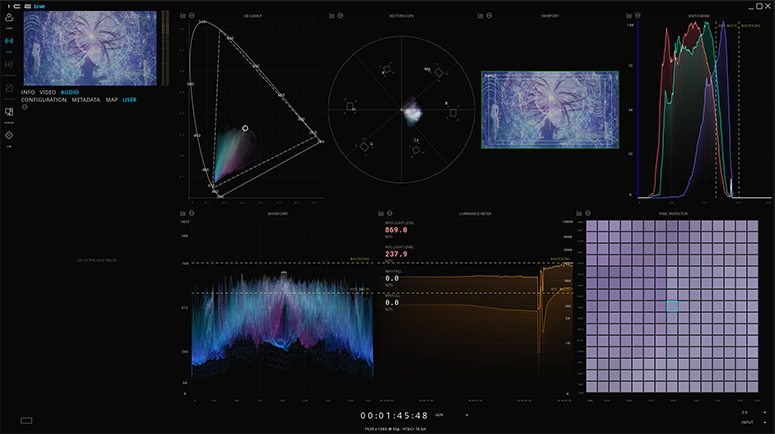
The video on DTV+ is PQ HDR10. ICE Live allows Globo to inspect the presence and integrity of the HDR10 metadata, while also providing the tools to visually assess and analyze the quality of the color-space conversion when an HLG-originated signal is converted to PQ HDR10.
This gives visibility into both the HDR information carried by the signal and the resulting image, helping ensure that the intended HDR experience is maintained throughout the workflow.
“When evaluating quality and optimal settings for DTV+ equipment, tools like ICE Live allow us to conduct an in-depth analysis of both video quality—where HDR technology delivers more striking images—and audio quality, where loudness and, in particular, MPEG-H features can be analyzed at the baseband stage before encoding. Visually verifying the MPEG-H authoring scene and even being able to listen to it using the MPEG-H rendering feature available in ICE Live was a great help to Globo during the DTV+ tests,” said Carlos Cosme, Technology Specialist at Globo.
“We are very pleased to work with Globo during this important transition,” said Laurence Stoll, CEO of Marquise Technologies. “The DTV+ deployment is a major step forward for broadcasting, and having the opportunity to test ICE Live with Globo in this environment is particularly meaningful for us. It demonstrates how monitoring needs to evolve as television becomes more immersive, personalized, and metadata-driven.”
Marquise Technologies is proud to work with Globo and contribute to the validation of the technologies shaping the next generation of broadcasting in Brazil.
As television evolves, monitoring must evolve with it. ICE Live is built to see the whole experience.